Fat32 Hard Drive Formatter Program
.gif)
The practice of formatting a hard drive on Windows has been around since ancient times when the operating system was inscribed onto wax tablets and tech-savvy ancients would know how to wipe the waxy slate clean. Today the process is more advanced though still fairly easy to do. Here we’ll tell you everything you need to know about formatting a hard drive on Windows 10 and how to do it. Note: Make sure you’ve backed up all your data if you’re formatting an existing drive. This guide shows you how to format a hard drive from within Windows. If, however, you want to format the drive that your OS is installed on, you’ll need to boot your PC to a Windows installation disc or ISO and do it from there. Related: Why Format a Hard Drive?
How to format a WD hard drive to exFAT or FAT32 file system. (macOS) format. For a hard drive to be able to be read from and written to on both a Windows and macOS computer, it must be formatted to ExFAT or FAT32 file format. FAT32 has several limitations, including a 4 GB per-file limit. Determine what program is accessing the drive. This article illustrates the easiest way on how to format 500GB Seagate/WD Passport external USB hard drive or internal HDD to FAT32 in Windows 10/8/7. AOMEI Partition Assistant Complete yet easy to use hard disk partition manager software to resize, move, merge, copy partitions, migrate OS, convert MBR/GPT disk without data loss.
Formatting is the process by which you wipe all data from a hard drive so that new data can be written over the top of it. There are a few different file systems you can format a drive to (NTFS, FAT32 and exFAT being the most popular), each of which works fine in Windows but may not work across different devices. If your computer has slowed down, you can hear your hard drive struggling with reading and writing (grinding clicking sounds in your PC), and you’ve tried everything else, then it might be time for a format. Alternatively, you may want to format a new hard drive you’ve just bought so it works in your PC. How to Format a Hard Drive Note: in Windows you cannot format the C: partition, as that is where the Windows system files are residing.
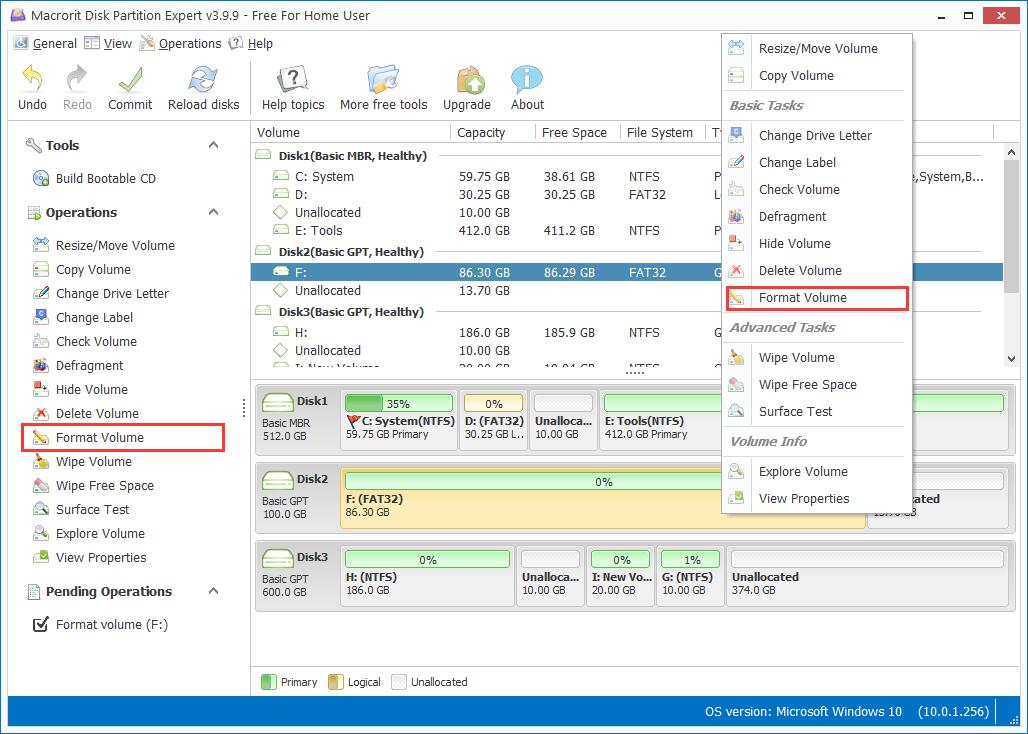
You can only format the secondary (or external) hard disk or another partition in the primary hard disk. To get a clearer picture of things, go to the “Disk Management utility” in Windows. (Press the Win key, type “disk management” and select “Create and format hard disk partitions”.) Here you’ll see all the hard drives – internal and external – connected to your PC. If you’ve just inserted a new hard drive, it should be listed, but the space within it will be “Unallocated.” If you want to format an existing active hard drive, you can do one of the following: • Right-click the drive you want to format and click “Delete volume,” which will turn that drive (or partition) into unallocated space and delete all the data on that drive. This is useful if you want to create partitions (more on that in a bit). • Alternatively, right-click the drive you want to format, and select “Format,” which will take you to the options for formatting your drive directly into a different file system.
Once you’ve selected the options that suit you, go ahead and click Next, then Finish. The drive or partition will be created, and you’ll see it in your Disk Management window. Notice that the other half of our drive is still Unallocated.
If we want to fill this up, we just repeat the process above but with the parameters we want for that partition. Conclusion That, in a nutshell, is how you format a hard drive using Windows 10.
Kristen Bell - One Way Or Another 69. Puracane things you should leave alone rare. Blondie - One Way Or Another 66. Earlimart - All they ever do is talk 67. Ivy - Feel So Free 68.
The same rules apply for SSDs, SATA drives, USB flash drives, and internal/external drives. Just remember to do all your backing up beforehand!
FAT32 and NTFS, Which is better for USB Stick? FAT32 and NTFS are different partition file systems that are widely used in Windows operating systems.
Huawei Global - • AFRICA• South Africa- • Morocco- LATIN AMERICA• Brazil - • Mexico - MIDDLE EAST • Saudi Arabia -, • United Arab Emirates - • ASIA PACIFIC• Australia - • China - • Hong Kong, China - • India - • Japan - • Korea - • Kazakstan - • Malaysia - • New Zealand - • Philippines - • Singapore - • Indonesia- • Thailand - • Turkey - NORTH AMERICA• Canada- • United States - • EUROPE• Austria - • Belgium -, • France - • Germany - • Italy - • Poland - • Sweden- • Russia - • Spain - • Switzerland - • United Kingdom. Huawei optix rtn 905.
One can between FAT32 and NTFS. USB flash drive is organized in cluster and the allocation unit size describes the size of a single cluster like other hard drives. Old as it is, FAT32 is still better file system for USB drive. Two main factors account for this: • Compatibility: Since it was created at an early time, FAT32 is compatible with virtually all operating systems. As a removable device, being moved around between different operating systems, XBOX, PS3/PS4, Android, etc. Is a common computing behavior.