Rccb Circuit Breaker Pdf

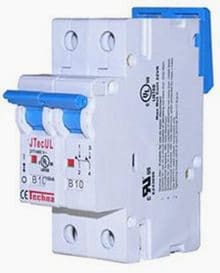
• • • A residual-current device ( RCD), or residual-current circuit breaker ( RCCB), is a device that instantly breaks an electric circuit to prevent serious harm from an ongoing electric shock. Injury may still occur in some cases, for example if a human falls after receiving a shock, or if the person touches both conductors at the same time [ ]. RCD is the name used in the. In the and, the terms ground fault circuit interrupter ( GFCI), ground fault interrupter ( GFI) or appliance leakage current interrupter ( ALCI) are used. If the RCD device has additionally overcurrent protection integrated in the same device, it is referred to as RCBO (see below). An (ELCB) may be a residual-current device, although an older type of voltage-operated earth leakage circuit breaker also exists. These devices are designed to quickly and automatically disconnect a circuit when it detects that the is not balanced between the supply and return conductors of a circuit.
Where the overcurrent protection or a circuit breaker cannot provide disconnection within the specified time because the earth fault loop impedance is too high, the addition of RCCB protection may well solve the problem without any other change in the system. Because of its high sensitivity to earth fault current and its rapid operating. Browse products from Schneider Electric - WW in residual current circuit breaker for ID-RCCB - Residual Current Circuit Breakers up to 125 A. View the new All Products menu. View the new All Products menu. Residual current circuit breaker ID - 4 poles - 63 A - class B 300 mA S. Hunza health secrets for long life and happiness pdf to word.
Any difference between the currents in these conductors indicates leakage current, which presents a shock hazard. Current of around 30 (0.030 amperes) through the human body is potentially sufficient to cause or serious harm if it persists for more than a small fraction of a second.
RCDs are designed to disconnect the conducting wires ('trip') quickly enough to prevent serious injury. RCDs are testable and resettable devices. A test button safely creates a small leakage condition, and a reset button reconnects the conductors after a fault condition has been cleared. Some RCDs disconnect both the energized and return conductors upon a fault (double pole), while a single pole RCD only disconnects the energized conductor. If the fault has left the return wire ' or not at its expected ground potential for any reason, then a single-pole RCD will leave this conductor still connected to the circuit when it detects the fault.
Contents • • • • • • • • • • • • • • • • • • • • • • • • • • • • • • • • • • Purpose and operation [ ] RCDs are designed to disconnect the circuit if there is a leakage current. By detecting small leakage currents (typically 5–30 mA) and disconnecting quickly enough (. Opened 3-phase residual-current device The diagram depicts the internal mechanism of a residual-current device (RCD). The device is designed to be wired in-line in an appliance power cord. It is rated to carry a maximal current of 13 A and is designed to trip on a leakage current of 30 mA. This is an active RCD; that is, it latches electrically and therefore trips on power failure, a useful feature for equipment that could be dangerous on unexpected re-energisation.
Some early RCDs were entirely electromechanical and relied on finely balanced sprung over-centre mechanisms driven directly from the current transformer. As these are hard to manufacture to the required accuracy and prone to drift in sensitivity both from pivot wear and lubricant dry-out, the electronically amplified type with a more robust solenoid part as illustrated are now dominant. The incoming supply and the neutral conductors are connected to the terminals at (1), and the outgoing load conductors are connected to the terminals at (2).